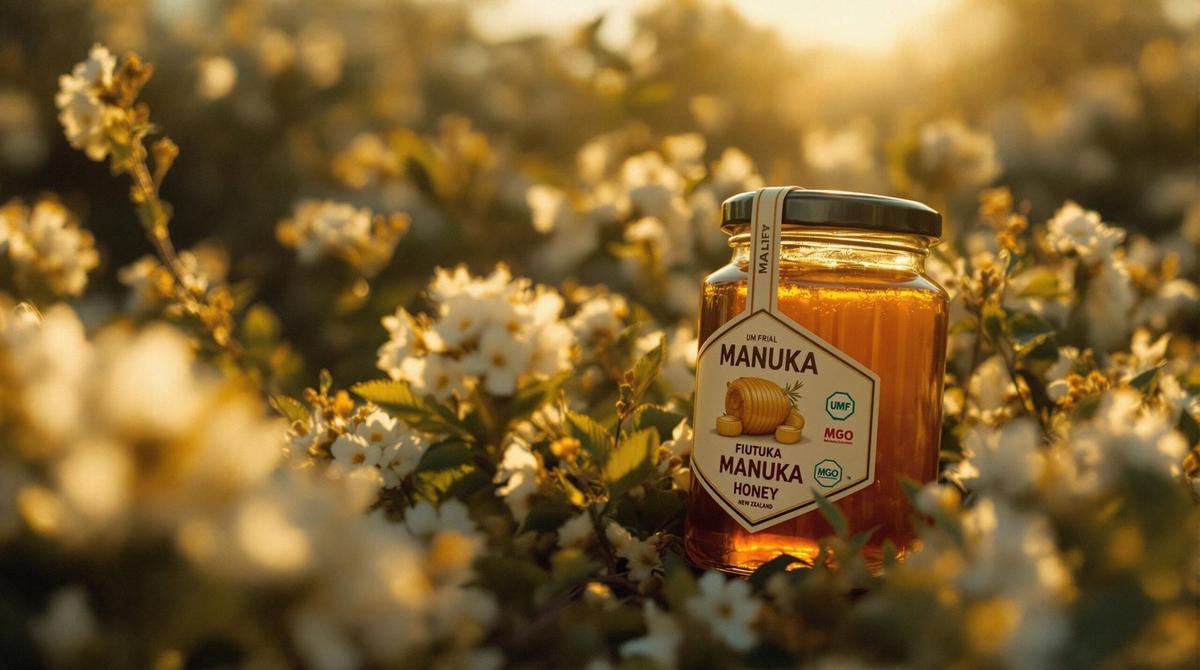
Navigating the world of Manuka honey can feel overwhelming with its complex rating systems, premium prices, and countless brands claiming authenticity. Whether you’re a first-time buyer or looking to upgrade your current honey selection, understanding the differences between UMF and MGO is crucial for making an informed purchase that delivers the real health benefits of manuka honey.
This comprehensive guide will demystify UMF vs MGO ratings for manuka honey products, help you identify authentic products, and ensure you get the best value for your investment. By the end of this article, you’ll confidently choose the right Manuka honey for your specific needs and budget.
What Makes Manuka Honey Special?
New Zealand manuka honey originates exclusively from these islands, where bees collect nectar from the native mānuka bush (Leptospermum scoparium). Genuine mānuka honey cannot be produced anywhere else in the world from this plant at scale, and honey from New Zealand is the only kind subject to the government definition described below. Unlike regular honey, Manuka honey contains unique bioactive compounds that provide exceptional antibacterial, antiviral, and anti-inflammatory properties.
Key distinguishing factors: ✅ Methylglyoxal (MGO): The primary active compound responsible for antibacterial properties ✅ Leptosperin: A natural marker found only in Manuka nectar, proving authenticity ✅ Dihydroxyacetone (DHA): Converts to MGO over time, indicating natural processing ✅ Limited harvest window: Manuka flowers bloom for only 2-6 weeks annually
🌟 Why Manuka Honey Commands Premium Prices
The extraordinary cost of authentic Manuka honey reflects several factors:
- Geographic exclusivity: Only produced in New Zealand’s remote wilderness areas
- Short harvest season: Limited annual production window
- Complex testing requirements: Every batch undergoes extensive laboratory analysis
- High global demand: Far exceeds the approximately 2,800 tonnes produced annually
- Strict quality controls: Rigorous standards for export and authenticity verification
Monofloral or Multifloral? New Zealand's Legal Definition of Mānuka Honey
Before you compare any grading system, there is a check that matters more than the number on the jar — and most buyers have never heard of it. Since 2018, every batch of mānuka honey from New Zealand exported from the country must be tested against a scientific definition set by the Ministry for Primary Industries, and classified as one of two types:
- Monofloral mānuka honey: Made predominantly from the nectar of the mānuka bush. This is the real thing, and it is what any therapeutic claim rests on.
- Multifloral mānuka honey: Contains mānuka nectar alongside a substantial amount of other nectar. Still a genuine New Zealand honey product, milder, and considerably cheaper — but not equivalent.
The test uses five markers: four chemical compounds found in mānuka nectar, plus a DNA marker from mānuka pollen. Honey that fails is simply not allowed to be labelled and exported as mānuka at all. This is why manuka honey from New Zealand carries a guarantee that identically-named honey from elsewhere does not.
The practical rule for shoppers: look for the word "monofloral" on the label first, and the UMF or MGO number second. A high MGO number on a multifloral honey is not the same product as monofloral manuka honey at the same grade, and the price should reflect that. Reputable honey producers state the classification plainly; anyone who hides it is telling you something.
Manuka Honey Grading Systems: UMF™ and MGO Explained
The two primary grading systems for manuka honey can be confusing — and the labelling on a jar of honey can be confusing on purpose — but each serves a specific role in helping you judge the quality and potency of manuka honey. The differences between UMF and MGO are worth ten minutes of your time before you spend a hundred dollars.
📊 UMF (Unique Manuka Factor) Rating System
Unique Mānuka Factor is a licensed quality mark administered by the Unique Mānuka Factor Honey Association — the UMF™ Honey Association, a New Zealand industry body — not a laboratory number a producer can print for itself. Only licensed packers may use it, and licensing requires the honey to be packed and tested in New Zealand.
The UMF number is a measure of Non-Peroxide Activity (NPA) — the antibacterial strength that survives when the hydrogen peroxide present in all honey is removed. UMF 15+ means the honey performs like a 15% phenol solution. The difference between UMF and MGO comes down to this: MGO is simpler, reporting one compound, while UMF certifies four.
What UMF Measures:
- Potency: MGO levels for antibacterial strength
- Authenticity: Leptosperin content proving Manuka origin
- Freshness: DHA levels indicating natural conversion process
- Shelf Life: HMF content showing heat treatment and age
UMF Rating Scale: Grade manuka honey typically runs from UMF 5+ to UMF 25+, and the manuka honey UMF number is what most New Zealand retailers lead with
- UMF 5+ to 10+: Daily wellness support
- UMF 10+ to 15+: Therapeutic grade for targeted health benefits
- UMF 15+ to 20+: Superior antibacterial grade for intensive use
- UMF 20+ and above: Premium medical grade for serious applications
💰 MGO (Methylglyoxal) Rating System
What MGO Measures: The MGO number reports the concentration of methylglyoxal in milligrams per kilogram — the level of MGO in the jar, and nothing else. Methylglyoxal is the compound found in manuka honey that does most of the antibacterial work, and it is unique to manuka among common types of honey, so the amount of MGO is a genuinely useful figure. What an MGO rating does not tell you is whether the honey has been overheated, how old it is, or whether it is monofloral.
MGO Rating Scale: The usual range of MGO ratings on retail shelves runs from 30+ to 1500+ or higher
- MGO 30+ to 100+: General wellness and daily consumption
- MGO 250+ to 400+: Moderate therapeutic benefits
- MGO 550+ to 800+: High potency for targeted health support
- MGO 850+ and above: Maximum strength for intensive applications
🎯 UMF vs MGO: Key Differences
| Factor | UMF Rating | MGO Rating |
|---|---|---|
| Testing Scope | Comprehensive (4 compounds) | Single compound focus |
| Authenticity Verification | ✅ Includes Leptosperin testing | ❌ MGO only |
| Freshness Guarantee | ✅ DHA and HMF testing | ❌ Not included |
| Shelf Life Assurance | ✅ Guaranteed potency duration | ❌ Not guaranteed |
| Origin Verification | ✅ Must be packed in New Zealand | ❌ Can be packed anywhere |
| Industry Recognition | ✅ Gold standard globally | ✅ Widely accepted |
UMF to MGO Conversion Chart: Matching the Two Ratings
Use this MGO chart to translate between the two systems. Because UMF measures NPA and MGO measures the concentration of MGO directly, the two track each other closely — MGO and NPA are different scales for the same underlying activity, which is why a reliable UMF to MGO conversion is possible at all:
| UMF Rating | Equivalent MGO | Typical Price Range (USD) | Best Use Cases |
|---|---|---|---|
| UMF 5+ | MGO 83+ | $20-$35 | Daily wellness, sweetener |
| UMF 10+ | MGO 263+ | $35-$60 | Digestive support, immunity |
| UMF 15+ | MGO 514+ | $60-$100 | Sore throat, wound care |
| UMF 20+ | MGO 829+ | $100-$150 | Medical applications |
| UMF 25+ | MGO 1200+ | $150-$250 | Premium therapeutic use |
Prices shown are approximate USD ranges for 250g jars and may vary by brand and retailer. New Zealand pricing typically ranges from $30-$400 NZD depending on grade.
🛡️ How to Identify Authentic Manuka Honey
With counterfeit products flooding the market, authentication is crucial for getting genuine benefits and value.
Essential Authentication Markers
✅ New Zealand Origin
- Look for “Product of New Zealand” or “Made in New Zealand” labels
- Verify the product hasn’t been blended or repackaged elsewhere
- Check for New Zealand government compliance statements
✅ Official Certification Marks
- UMF® trademark: Licensed by the UMF Honey Association
- MPI compliance: New Zealand Ministry for Primary Industries approval
- Independent laboratory testing: Third-party verification certificates
✅ Proper Rating Display
- Clear UMF or MGO rating prominently displayed
- License numbers for UMF-certified products
- Batch numbers for traceability
🚨 Red Flags to Avoid
❌ Suspiciously low prices: Authentic Manuka honey cannot be produced cheaply ❌ Vague labeling: Terms like “Active,” “Bio-Active,” or “K-Factor” without official ratings ❌ Multiple origin claims: Genuine Manuka only comes from New Zealand ❌ Missing batch information: Legitimate producers provide full traceability ❌ Unrealistic claims: Medical claims without proper disclaimers
Choosing the Right Manuka Honey for Your Needs
Selecting the optimal grade depends on your intended use, health goals, and budget considerations.
🍯 For Daily Wellness and General Health
Recommended Grades: UMF 5+ to 10+ (MGO 83+ to 263+) Price Range: $20-$60 USD ($30-$90 NZD)
Perfect for:
- Daily immune system support
- Natural sweetener replacement
- General wellness maintenance
- First-time Manuka honey users
🎯 For Targeted Health Benefits
Recommended Grades: UMF 10+ to 15+ (MGO 263+ to 514+) Price Range: $60-$100 USD ($90-$150 NZD)
Ideal applications:
- Digestive health support
- Seasonal allergy management
- Skin care applications
- Enhanced immune response during illness
💪 For Therapeutic and Medical Use
Recommended Grades: UMF 15+ to 20+ (MGO 514+ to 829+) Price Range: $100-$200 USD ($150-$300 NZD)
Best suited for:
- Wound healing and skin treatment
- Severe digestive issues
- Post-surgical recovery support
- Professional healthcare applications
🏆 For Maximum Potency Applications
Recommended Grades: UMF 20+ and above (MGO 829+) Price Range: $200+ USD ($300+ NZD)
Specialized uses:
- Serious medical conditions (under healthcare supervision)
- Advanced wound care
- Research and clinical applications
- Premium gift giving
💡 Smart Shopping Tips for Manuka Honey
Budget-Conscious Strategies
🎯 Start with mid-range grades: UMF 10+ offers excellent value for most users 🛒 Buy during sales: Many retailers offer seasonal discounts 📦 Consider smaller sizes: Try 250g jars before investing in larger quantities 🔍 Compare price per MGO: Calculate cost per unit of active compound
Quality Verification Methods
📱 QR Code Scanning: Many premium brands provide batch-specific information 🔬 Request lab certificates: Legitimate suppliers provide test results 📞 Contact manufacturers: Verify license numbers and batch authenticity 🌐 Check official databases: UMF Association maintains member directories
Storage and Shelf Life Considerations
🏠 Proper storage extends potency:
- Store in cool, dry conditions (below 77°F/25°C)
- Keep away from direct sunlight
- Use clean, dry utensils to prevent contamination
- Check expiration dates and batch information
Heat, Storage and Getting Your Money's Worth
A high grade is worth nothing if the honey has not been handled properly. Methylglyoxal degrades with heat, which is why UMF certification also verifies that the honey has not been overheated during processing — one of the few practical differences between UMF in manuka honey and a bare MGO number. At home, keep the jar in a cupboard rather than a sunny windowsill, use a dry spoon, and never microwave it or stir it into boiling water. Warm, not hot, is the rule if you are taking manuka honey in a drink.
Manuka honey can be used in more ways than most buyers realise: a teaspoon straight off the spoon, stirred into warm (not boiling) water with lemon for a sore throat, or applied topically to minor wounds — medical-grade manuka dressings are used in hospitals for exactly this reason. Whatever you choose, opening the jar is the point. A great many people buy a very expensive quality honey, decide it is too precious to eat, and find it still sitting in the cupboard two years later.
If you are shopping for other things to take home as well, Manuka is only one item on a long list — see our guide to the best New Zealand souvenirs, including where supermarkets beat the tourist shops on price.
Global Purchasing Considerations
Shipping and Import Regulations
Different countries have varying regulations for honey imports. Always verify:
- Customs requirements vary by destination country
- Organic certification may require additional documentation
- Temperature control during shipping affects quality
- Import duties add to total cost considerations
Currency and Pricing Factors
Exchange rates significantly impact international purchases:
- USD to NZD fluctuations affect pricing for direct imports
- Local retailers may offer more stable pricing
- Bulk purchasing often provides better value for regular users
- Seasonal availability influences market prices
Where to Buy Authentic Manuka Honey
Recommended Purchase Channels
🏪 Authorized Retailers:
- Health food stores with verified supplier relationships
- Pharmacies carrying medical-grade products
- Specialty honey shops with authentication guarantees
🌐 Online Platforms:
- Official brand websites with direct shipping
- Verified e-commerce sellers with authentication certificates
- Specialty health retailers with quality guarantees
⚠️️ Purchase Precautions:
- Avoid marketplace sellers without verification
- Be skeptical of heavily discounted premium grades
- Verify return policies for quality issues
- Check customer reviews for authenticity concerns
Maximizing Your Manuka Honey Investment
Usage Guidelines for Different Grades
Daily Consumption Amounts:
- Lower grades (UMF 5-10+): 1-2 teaspoons daily
- Medium grades (UMF 10-15+): 1 teaspoon daily
- Higher grades (UMF 15+): ½ teaspoon daily or as directed
Application Methods:
- Direct consumption: Most effective on empty stomach
- Topical application: Clean skin before applying thin layer
- Beverage addition: Add to warm (not hot) liquids to preserve properties
- Culinary use: Lower grades work well for cooking applications
Combining with Other Natural Remedies
Manuka honey pairs effectively with:
- Ginger and lemon for digestive support
- Turmeric for anti-inflammatory benefits
- Propolis for enhanced immune support
- Essential oils (externally) for skin applications
Conclusion
Choosing the right Manuka honey requires understanding both UMF and MGO rating systems, verifying authenticity, and matching grades to your specific needs and budget. While UMF provides more comprehensive quality assurance, MGO offers straightforward potency measurement.
Key takeaways for smart purchasing:
- Prioritize authentic New Zealand origin and proper certification
- Start with mid-range grades (UMF 10+ or MGO 250+) for best value
- Verify authenticity through official channels and documentation
- Consider your intended use when selecting potency levels
- Factor in storage, shipping, and currency considerations for international purchases
Remember that authentic Manuka honey is an investment in your health. While prices may seem high compared to regular honey, the unique therapeutic properties and limited global supply justify the premium for those seeking genuine wellness benefits.
Always consult with healthcare professionals before using Manuka honey for medical purposes, especially if you have allergies, diabetes, or are taking medications.
Useful Resources:
Disclaimer: This article has been generated using AI and aims to provide the most current and accurate information possible. However, information may become outdated or change over time. For variable information such as fees and operating hours, please always verify the latest information through official websites. This article is intended for general information purposes and is not individualized advice. Content may be updated in the future based on personal experiences and additional information.