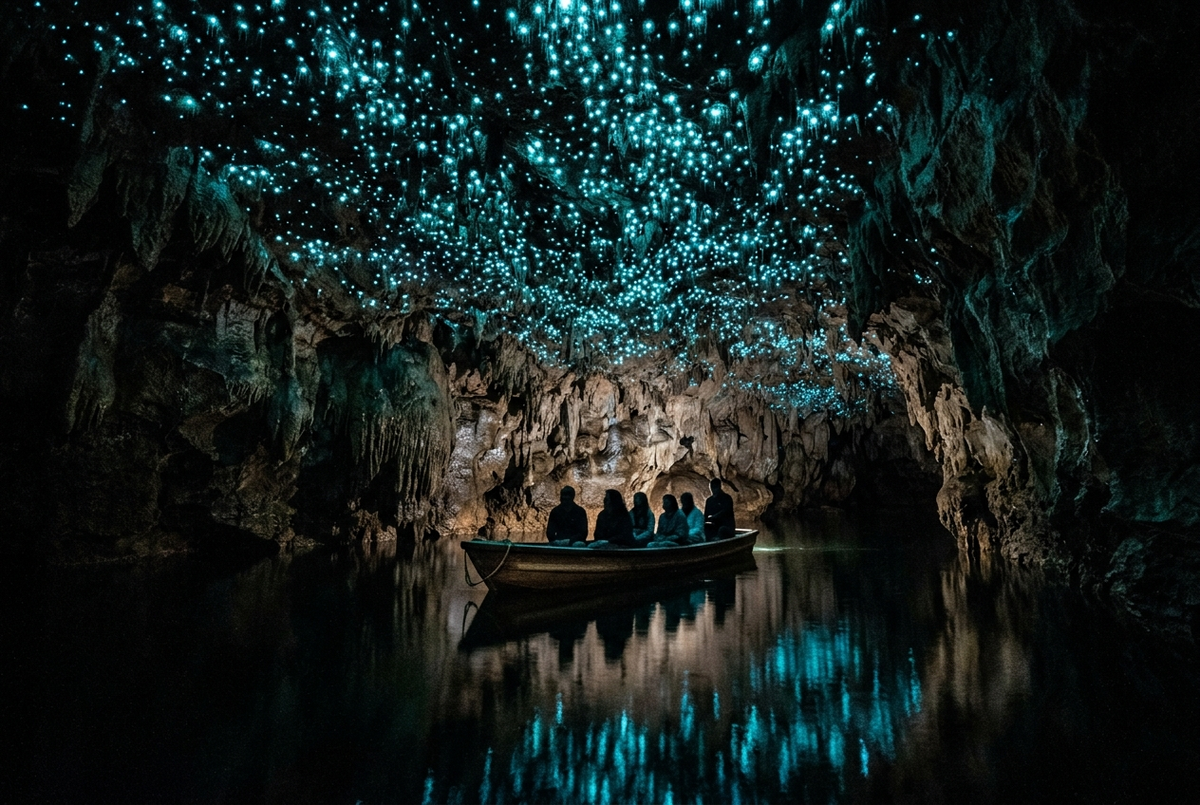
If you are planning a trip to New Zealand and sketching out a North Island road trip itinerary, the famous Waitomo Glowworm Caves are the stop most travellers slide in between Auckland and Rotorua. The reason is a boat ride under the glowworms: you sit in silence in a flat-bottomed boat, the guide pulls it along by hand, and the ceiling of the cavern above you fills with blue-green pinpricks of light. It is regularly described as one of New Zealand's most popular experiences, and it is genuinely one of the country's oldest tourist attractions — people have been guided through this cave for more than 130 years.
What most first-timers do not realise is that there is no single ticket. There are three separate show caves here, two underground rafting trips, several combo deals and a free bush walk, and they leave from different places at different prices. This guide lays out what each one costs, how long it takes, what you actually see underground, and how to fit a visit to the Waitomo Glowworm Caves into the rest of your trip. All prices are in New Zealand dollars and correct as of August 2026 — always confirm on the official Discover Waitomo site before you book.
What the Waitomo Glowworm Caves are, and what the name means
The name comes from the Māori words wai (water) and tomo (hole or shaft): a stream that disappears into a hole in the ground. That is exactly what the place is. The area was a seabed 30 million years ago, and today it is a landscape of limestone caves, sinkholes and underground rivers, with a whole cave system running beneath farmland in the Waikato.
The caves are a taonga — a treasure — to Ruapuha Uekaha Hapū, and the operator describes its role as kaitiaki, or guardian, alongside running the tours. Many of the staff you meet are direct descendants of the chief who first opened the cave to visitors. That history matters more here than at most tourist sites in New Zealand, and it is worth knowing before you go.
One small note for searchers: you will see this written as glow worm cave, glow-worm caves and glowworm caves in different places. They are all the same thing. The official name of the main Waitomo cave is the Waitomo Glowworm Caves, and the three caves plus the rafting trips are run by the same operator, so a single booking can cover more than one.
The three caves in Waitomo compared: price, duration and access
Underground Waitomo is bigger than the single tour most people book. The Waitomo Caves New Zealand is famous for are really three separate attractions with three separate tickets, listed side by side below. Photography rules and wheelchair access differ sharply between them, and for some visitors that decides the choice before price does.
| Cave | Adult | Child | Family (2 adults + 2 children) | Duration | What you see | Photography | Wheelchair access |
|---|---|---|---|---|---|---|---|
| Waitomo Glowworm Caves | NZ$81 | NZ$37 | NZ$207 (extra child NZ$29) | 45 minutes | Guided walk, the Cathedral chamber, then a silent glide by boat | Not allowed at all | No |
| Ruakuri Cave | NZ$116 | NZ$44 | NZ$281 (extra child NZ$42) | About 1.5–2 hours | Spiral entrance, stalactites and crystal tapestries, glowworms close up | In designated areas only | Yes, fully accessible |
| Aranui Cave | NZ$81 | NZ$37 | NZ$206 (extra child NZ$29) | 1 hour | Pink, white and pale brown formations — no glowworms | Allowed | Check with the operator |
Important: Aranui is currently closed for maintenance. A reopening is planned for 14 September 2026, but that date is not confirmed, so check the official page before you build it into your plans.
Which cave tour should you choose?
Waitomo Glowworm Caves: the classic boat ride
This is the one people mean when they say Waitomo. The glowworm cave tour lasts 45 minutes: a guided walk through the cave, including the largest chamber, known as the Cathedral, and then the boat ride through the Glowworm Grotto in complete silence. Boats carry no more than 23 people, and you are asked not to talk, because glowworms react to noise. Photography and video are banned outright, so this is the one part of your trip you will have to remember rather than record.
Practical details: it runs daily from 9:00 to 17:00, children under 4 go free but still need to be booked in, anyone 15 or over counts as an adult, and the child rate on the family pass covers up to age 14. Under-5s must wear a life jacket, which is supplied. The cave holds a steady 16–17°C all year, so bring a layer even in February. There are handrails and a made path, but the main cave is not wheelchair accessible and is best suited to people with reasonable mobility.
Ruakuri Cave: the largest cave in the Waitomo region
Ruakuri is the biggest of the three and, for a lot of visitors, the better tour. You enter through a dramatic spiral man-made entrance to the cave and walk for roughly 1.5 to 2 hours — the official pages vary slightly on the exact duration — past limestone formations and shimmering crystal tapestries, with glowworms visible close overhead rather than far up a ceiling. It is also lit by solar power.
Ruakuri is fully accessible to wheelchairs and pushchairs, and the operator describes it as the only wheelchair-accessible cave in the Southern Hemisphere. The passages are narrow, so chairs need to be within 65 cm wide and you should contact the team in advance. Photography is allowed in designated areas only, and tripods and selfie sticks are not permitted on the standard walking tours — there is a separate photography tour if that is your priority. Large backpacks cannot be taken in.
The catch is the meeting point. Tours leave from the Ruakuri Visitor Centre on Tumutumu Road, not the main village centre, so you need your own transport. Departures run from 10:00, with the last at 15:30. There is also a deal worth knowing about: for bookings travelling between 6 July and 31 August 2026, one child goes free with each paying adult. Details are on the official Ruakuri page.
Aranui: stalactites and stalagmites, but no glowworms
Aranui is the outlier. No river runs through it, which means there are no glowworms — what you get instead is an hour among some of the finest cave formations in the area: pale brown, pink and white columns, plus a colony of native cave weta near the cave entrance. Photography is allowed here, as long as you never touch the rock formations. You check in at the main visitor centre at 39 Waitomo Village Rd and then drive yourself about 10 minutes to Ruakuri Reserve. Remember that it is closed for maintenance at the time of writing.
Combo tickets: two caves in one Waitomo experience
If you want more than one cave, the combos are cheaper than buying separate tickets:
- Most Popular Combo (Glowworm + Ruakuri) — adult NZ$170, child NZ$76, family NZ$410 (extra child NZ$59), 2.5 hours. Pairing Ruakuri Cave and Waitomo Glowworm Caves is the standard choice: your first cave is the boat ride, your second cave is the long walking tour.
- Top Cave Combo (Ruakuri + Aranui) — adult NZ$170, child NZ$76, family NZ$411, 2.5 hours.
- Twin Cave Combo (Glowworm + Aranui) — adult NZ$125, child NZ$53, family NZ$272, 2 hours.
A three-cave ticket is not currently on sale, which fits with the third cave being closed. Both combos that include it depend on it reopening, so treat them as provisional and check the current combo deals before counting on one.
What glowworms actually are: Arachnocampa luminosa, endemic to New Zealand
The New Zealand glow-worm is Arachnocampa luminosa, a species found nowhere else on earth. Despite the name it is not a worm and not a beetle: it is the larva of a fungus gnat in the family Keroplatidae. New Zealand has more than 300 fungus gnat species, and this is the only one that glows.
The light is a specific blue-green, at a wavelength of 487 nm. It comes from an organ at the rear end of the larva, formed from modified Malpighian tubules. The chemistry is unusual: the enzyme is a firefly-type luciferase that shares only 31% of its sequence with a firefly's, and it acts on an entirely new luciferin. The substrate turns out to have two components, tyrosine and xanthurenic acid — put together, they produce roughly 18 times the light that either does alone.
What the glow is for is less romantic than it looks. The larva uses it to attract small insects in the dark, then catches them on sticky silk snares hung from the ceiling. Every stage of the life cycle except the egg glows, but the larvae are the brightest, which is why they are what you see. The whole life cycle takes 11–12 months, of which 8–9 months are spent as a larva; a larva takes six to nine months to reach its full 3–4 cm.
One thing worth flagging: plenty of listings invite you to marvel at thousands of magical glowworms, or even millions of glow worms. The operator does not publish a count, so treat those numbers as marketing rather than fact. The glow worms in the Waitomo caves are impressive enough without them.
Black water rafting: the wilder Waitomo adventures
If floating past the lights is too gentle, the same operator runs tubing trips through a subterranean river in the dark. Two are on offer, and the difference between them is significant.
Black Labyrinth — 3 hours, from age 12
You raft an underground river on a tube, jump backwards off a waterfall, and drift through a glowworm-covered stretch of Ruakuri on pitch black water. It costs NZ$193 for adults, NZ$149 for youth aged 12 to 15, and NZ$571 for a family of two adults and two youths, and takes 3 hours. You need to be at least 12 years old and 45 kg, with moderate fitness. No caving experience is required.
Black Abyss — 5 hours, from age 16
The bigger one: you abseil into the dark, ride a zip line, tube the river and climb back out up underground waterfalls. It costs NZ$322 for adults and runs 5 hours, which includes the safety briefing, gear fitting, transfers and training. You must be 16 or over and at least 45 kg, and in good physical condition. See the official rafting pages for the full conditions.
For both trips you do not have to be a strong swimmer, but you do need to be comfortable in water. Wetsuit, socks, boots, helmet, light and tube are all supplied; you bring your own swimwear and towel, because towels are not hired out. There are separate men's and women's changing rooms, hot showers and lockers at the base. Cameras and GoPros cannot be taken underground — guides take photos you can buy afterwards. The base is at 585 Waitomo Caves Road, Waitomo 3977 (0800 228 464), open 8:00 to 16:30, 364 days a year with Christmas Day the exception. There is also a promo code, MATES, giving 25% off bookings and departures between 29 May and 31 August 2026.
Getting there: drive times, coaches and guided tours
Waitomo sits inland in the Waikato, south of Auckland. The visitor centre is at 39 Waitomo Village Rd, Waitomo Caves (0800 456 922). Official driving times are:
- Hamilton — 1 hour
- Bay of Plenty — 2 hours
- Auckland — 2.5 hours
- Taranaki — 3 hours
Self-driving is the most flexible option, and it is effectively required if you want Ruakuri or the third cave, since both need you to get yourself to a second meeting point. Without a car, InterCity coaches run from the SkyCity terminal at 102 Hobson St to Waitomo in about 3 hours 40 minutes, five services a week, and from the Rotorua i-SITE, departing at 7:45, in about 2 hours 25 minutes.
The other option is a guided coach tour. The awesomeNZ "Waitomo Caves and Hobbiton Movie Set Tour from Auckland" costs NZ$360 for an adult and runs 10 hours 45 minutes, leaving SkyCity at 7:45 and returning at 19:15. It includes the coach, a guided cave tour at Waitomo, a guided tour of the Hobbiton Movie Set, one drink and a picnic lunch. Guiding is in English only. If you would rather build the pairing yourself, see our guide to the Hobbiton Movie Set — the two sit close enough together that most Waitomo caves tours and self-drive itineraries treat them as a pair.
Booking, check-in and payment
Advance booking is essential, not optional. Summer dates sell out, and turning up hoping for a spare seat is a bad plan — although extra departures are added over summer, which helps if you book early.
Check in 30 minutes before your departure time. If you are late, your booking is forfeited and there is no refund; with a 45-minute tour running on a tight rotation, there is no slack in the schedule. All three cave sites and the rafting base are cashless, so bring a card rather than notes.
Weather is rarely a problem. Ordinary rain does not stop the tours; only prolonged heavy rain affects them. General logistics are covered on the operator's own plan-your-visit pages.
What to wear, and the photography rules inside the cave
Wear comfortable walking shoes with non-slip soles — sections of the walkway are wet and slippery — and bring a warm layer, because it is cool underground whatever the season. Leave the tripod behind.
The camera rules are worth repeating, because they catch people out. In the main Glowworm Cave, photography and video are banned entirely; within the cave, you look and that is it. At Ruakuri you can shoot only in designated areas, without a tripod or selfie stick on a standard tour. At Aranui you can photograph freely, as long as you do not touch the formations — so if you want photographs, those are the two tours to bring a camera to.
What language are the tours in?
Tours run in English. The official website has Chinese-language pages but no Japanese-language pages, and the individual tour pages do not advertise language-specific guiding, audio guides or translated brochures. The awesomeNZ day tour states explicitly that its guiding is English only. If you need support in another language, ask the operator directly when you book rather than assuming — and note that a good part of the main tour is spent in silence anyway.
A short history of the cave: 1887 to 1989
In 1887 the local Māori chief Tāne Tinorau and an English surveyor, Fred Mace, made the first serious exploration of the cave. They built a raft from flax stems, took candles as their only light, and floated in from the point where the stream goes underground. The first thing they found was the Glowworm Grotto — countless lights on the ceiling, doubled in the water below them.
By 1889 Tāne Tinorau and his wife Huti had opened the cave to visitors, guiding people through themselves for a small fee. In 1906 the government took over the administration of the cave, and it was not until 1989 that the land and the cave were returned to the descendants of the original owners. Ruakuri has an older story again: its name comes from rua (den) and kuri (dog), and in Māori tradition it was found 400 to 500 years ago by a young hunter.
The free Ruakuri Bush Walk, one of the best places to visit nearby
Not everything here costs NZ$81. The Ruakuri Bush Walk is a free loop track, described by the operator as one of New Zealand's best short walks, and it takes in the Ruakuri Natural Tunnel and the hidden entrance to Aranui. The Department of Conservation describes a forested gorge, naturally sculpted cliffs and low limestone arches, with a viewing deck above the underground Ruakuri Natural Bridge. Go back at night and you can see glowworms for nothing — the foot of the main bridge is the best spot.
It is not a stroll: there are a lot of steps and some steep sections, so it suits people with no walking difficulties, and you will need to watch your head where the rock overhangs come down low. It is 4 km from Waitomo village — head west, turn left at the roundabout onto Tumutumu Road, then right at the signpost about 2 km along to reach the car park. The village itself has cafés, bars and several other bush walks, so there is more than one reason to stay past your tour time.
Waitomo FAQ
How much is a ticket to the Waitomo Glowworm Caves?
NZ$81 for an adult and NZ$37 for a child, or NZ$207 for a family of two adults and two children, as of August 2026. Third-party sites still quote much older figures, so check the official page before you budget.
How long does the glowworm tour take?
The main cave tour is 45 minutes, including the boat ride. Ruakuri takes about 1.5 to 2 hours, Aranui 1 hour, and the two-cave combos 2 to 2.5 hours.
Can I take photos in the caves?
Not in the main Waitomo Glowworm Caves — photography and video are prohibited. Ruakuri allows photography in designated areas without a tripod, and Aranui allows it throughout.
Is Waitomo wheelchair accessible?
Ruakuri is fully accessible to wheelchairs and pushchairs, with the caveat that chairs must be no wider than 65 cm and you should get in touch beforehand. The main Glowworm Cave is not wheelchair accessible.
Is Waitomo worth it as a day trip from Auckland?
It is 2.5 hours each way by car, so yes, provided you commit the day to it. A guided coach tour that also covers the Hobbiton Movie Set runs 10 hours 45 minutes door to door, which gives you a sense of the commitment involved.
The bottom line
Waitomo is one of the natural wonders that earns its reputation. For NZ$81 the main cave experience is 45 minutes long and leaves most people quietly spellbound, and if you have a spare hour or two, adding Ruakuri gives you something that feels nothing alike. Book ahead, arrive 30 minutes early, bring a warm layer and grippy shoes, and accept that the best glowworm caves in New Zealand are one sight you carry home in your head instead of your camera roll.
Prices and policies change. Please confirm the latest details on the official website before booking.