Most people come to New Zealand for the scenery and the adrenaline, but here's the thing — this country is also a treasure trove for wildlife watching. Penguin nesting grounds you'll find almost nowhere else on Earth, a stretch of coast where whales show up year-round, caves that glitter with glowworms in the dark. Better still, many of these spots require no special gear or expedition-level planning to visit.
This guide pulls it all together: what you can see, where to find it, and how to make it happen. Use it as a map for weaving wildlife encounters into your travel route.
What Can You See Where? A Quick Regional Guide
Let's start with the big picture. Here are the headline animals and their best-known viewing areas.
| Animal | Main areas | How to see them |
|---|---|---|
| Yellow-eyed penguin | Dunedin (Otago Peninsula), The Catlins | Viewing hides / guided tours |
| Little blue penguin | Oamaru | Watch the evening landing |
| Sperm whale | Kaikoura | Whale-watching cruise (year-round) |
| Kiwi | Wildlife centres / sanctuaries | Visit a facility or join a night tour |
| Glowworms | Waitomo and others | Cave tours |
Notice how the marine wildlife spots cluster along the South Island's east coast — Oamaru, Dunedin, The Catlins, Kaikoura. If you're planning a South Island road trip, building your route around wildlife watching is a genuinely good strategy.
Two Penguins to Know: Yellow-Eyed and Little Blue
New Zealand has two penguin species that are relatively easy for travellers to see.
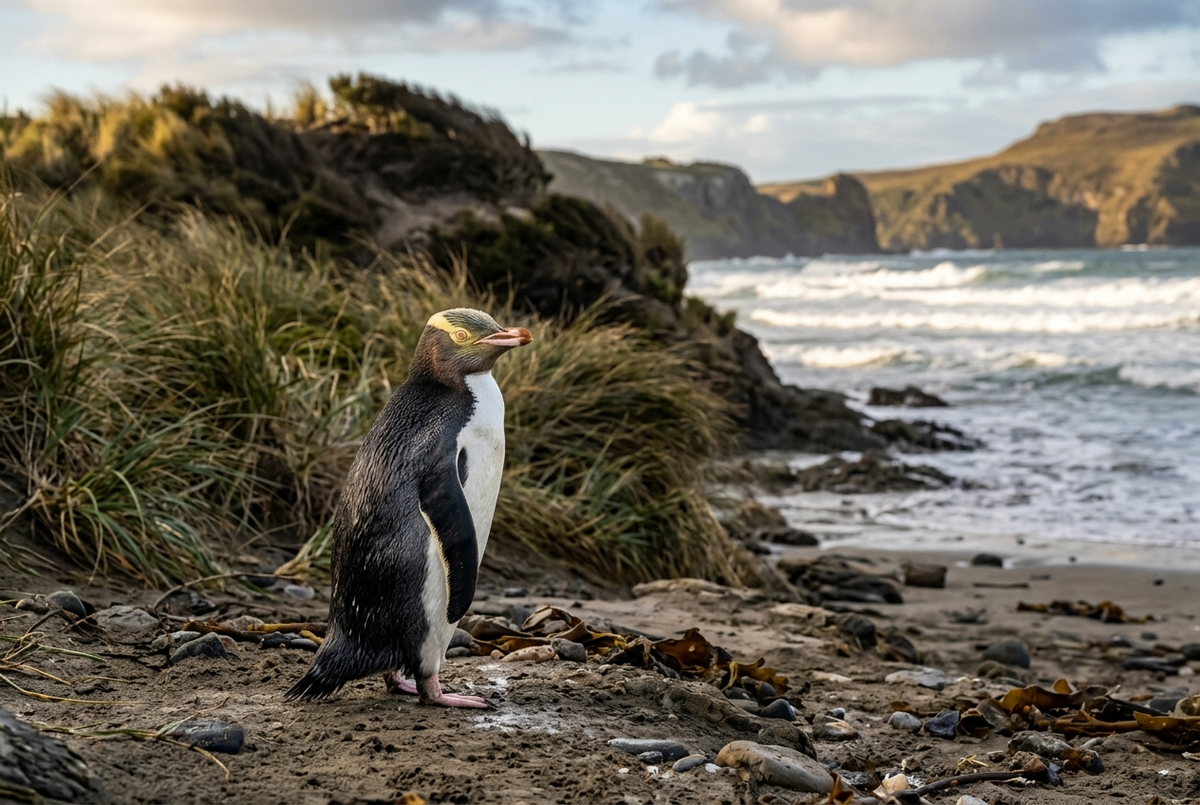
- Yellow-eyed penguin: The Otago Peninsula near Dunedin and The Catlins further south are the strongholds. This rare species — named for its distinctive yellow eye band — must be observed quietly and from a distance, no exceptions.
- Little blue penguin: Oamaru is the famous spot. The penguins spend the day fishing at sea and waddle home to the shore in groups at dusk, so watching the evening "commute" has become the classic way to see them.
Both are wild animals, so how many you'll see depends on sea conditions and the day itself. Check local signage and official websites for viewing hours and rules.
Whales: Kaikoura, Any Time of Year
If whales are your goal, Kaikoura on the South Island is the place. It's one of the very few spots in the world where sperm whales can be seen year-round — a huge plus for travellers, since you don't have to time your trip around a season.
For cruise prices, sighting rates, the best seasons, and seasickness tips, see our full Kaikoura whale watching guide. If whales are going to be the highlight of your trip, it's worth a read.
How to Actually See a Kiwi
Here's an honest truth about the national bird: spotting a kiwi in the wild is genuinely difficult. They're nocturnal, so a chance wild sighting is highly unlikely. That leaves two realistic options:
- Visit a wildlife centre: Places like Willowbank in Christchurch (entry NZ$36.50, as of August 2026) care for and breed kiwi, giving you a guaranteed look at the bird.
- Join a guided night tour: Head out with a guide after dark, when kiwi are active. There's a luck factor, but it's your best shot at seeing one in a near-wild setting.
Wellington also has a vast bird sanctuary right on the edge of the city, where you can see many of New Zealand's endemic birds in one visit. Read more in our Zealandia nature sanctuary guide.
Glowworm Caves: A Starry Sky Underground
Countless blue lights twinkling across a cave ceiling — glowworms are a uniquely New Zealand experience. The classic destination is the Waitomo Caves on the North Island, with adult entry from NZ$61 (as of August 2026). You drift through the pitch-black cave by boat, gazing up at a ceiling full of lights. Visitors often describe it as floating beneath a night sky.
The Rules: Keep Your Distance, Never Feed
Finally, the ground rules that apply to all wildlife watching here.
- Keep your distance from wild animals: Getting too close stresses them and can affect breeding. Use your zoom lens instead.
- No feeding — ever: That includes the cheeky, friendly kea you might meet in the mountains. Human food harms their health. Learn more in our kea (alpine parrot) guide.
The reason New Zealand's wildlife can still be seen up close is precisely because generations of visitors have respected these rules. Follow the same etiquette, and we keep this remarkable closeness alive for the travellers who come after us.
New Zealand is home to the world's smallest penguin: the little blue penguin, standing just about 30 cm tall. In Oamaru, their evening return from the sea has become a full-blown tourist event, with crowds gathering to watch the tiny commuters march home from a day's fishing.
Prices and policies can change. Please check official websites for the latest information.